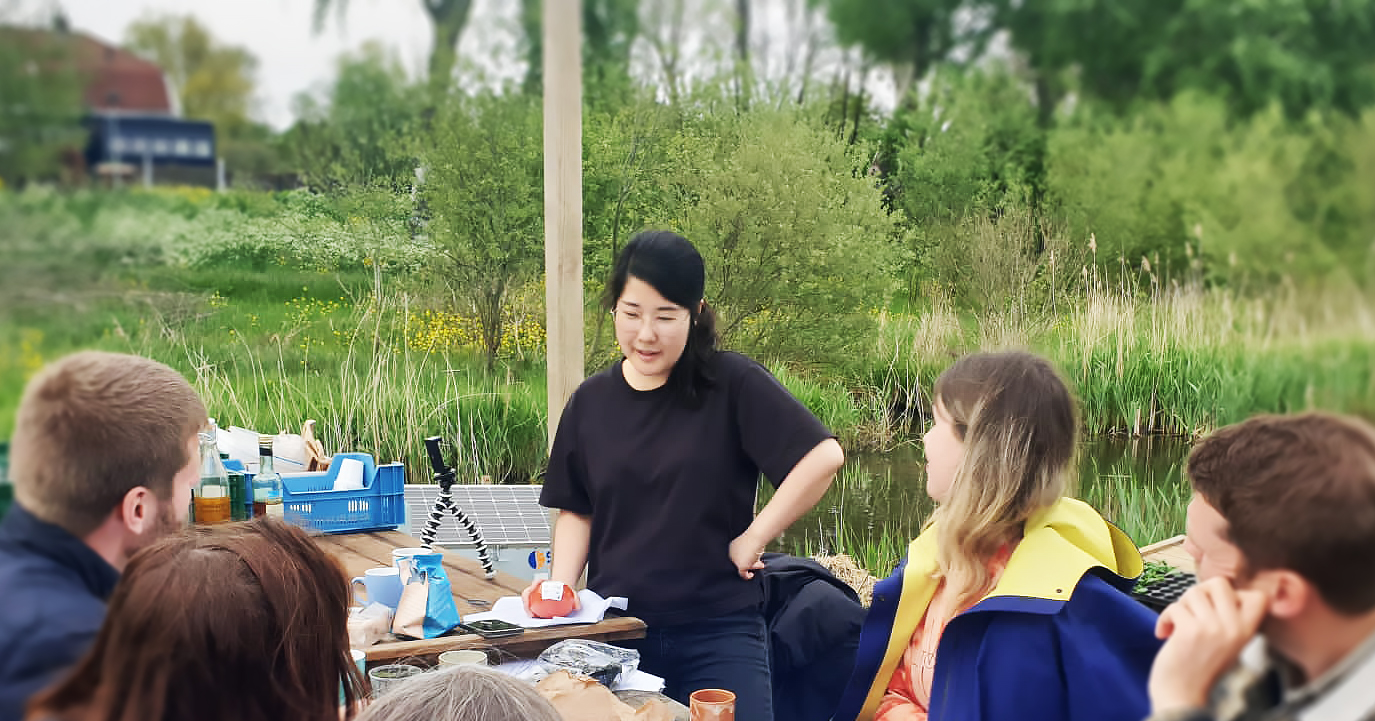
YOUNGSIL LEE
ECOLOGICAL ACTION DESIGNER & SYSTEMS THINKER
Youngsil Lee is a PhD candidate in Design Informatics at the University of Edinburgh. She is part of DCODE Network (Marie Skłodowska-Curie grant No. 955990) and works with Larissa Pschetz, Bettina Nissen, Chris Speed, and Rachel Smith. As an interdisciplinary design researcher from South Korea, she brings together academic and industry expertise in food biology, design, digital technology, and ecology with an international and cultural perspective.
As an ecological action designer, she creates collective, place-based and reflexive actions and empowers plural knowledges—as ways of knowing, being, and doing—that connect diverse people, strange critters, and more-than-human ecologies. Through the following research focuses, she explores design-driven questions such as “How can design help us regenerate our ecological sensitivity and responsibility towards co-living/making worlds?”
- Data & Technology, Socio-ecological systems, Agriculture & Food, and Sustainability
- More-than-human, New materialism, Eco-Feminism
- Critical & Speculative Design and Participatory Design
Research
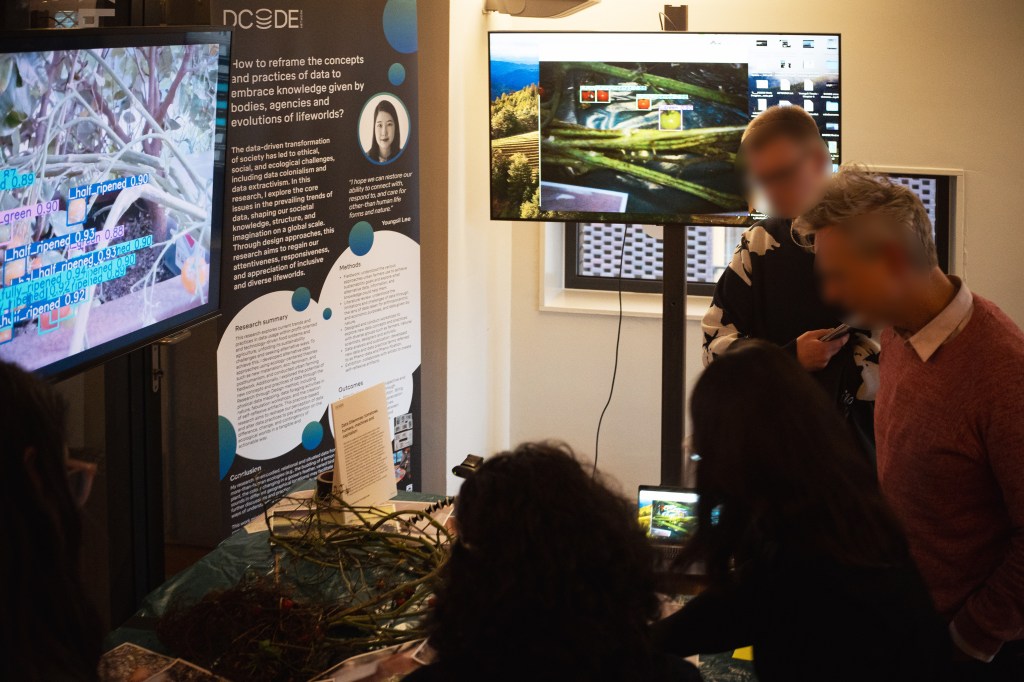
Data Dilemmas: Tomatoes, Humans, Machines and Capitalism
A self-reflective artwork emerged through interdisciplinary discussions with a bio-artist and biologists. By tracking a dying tomato plant through an AI maturity-detection sensor, this artwork reveals the limitations of data science in capturing life’s rich forms, manifestations, and stories. “What rich stories might dying tomato plants whisper to us beyond the narrow gaze of machine vision?”
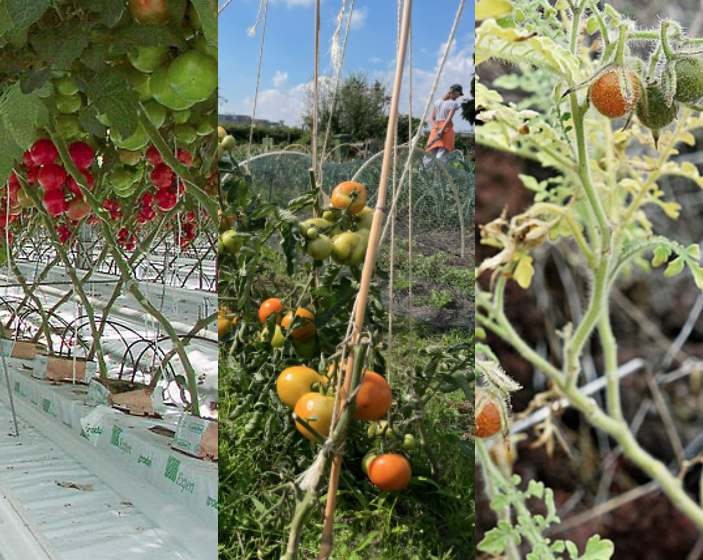
Three Tomatoes Fabulation
In this Alt.CHI paper, we introduce different tomato entities to help us explore new ways of looking at data. From an other-than-human perspective, we consider how a greenhouse tomato, an heirloom tomato, and a wild tomato perceive and embody data differently in the world, deriving lessons from these distinct viewpoints within the field of HCI.
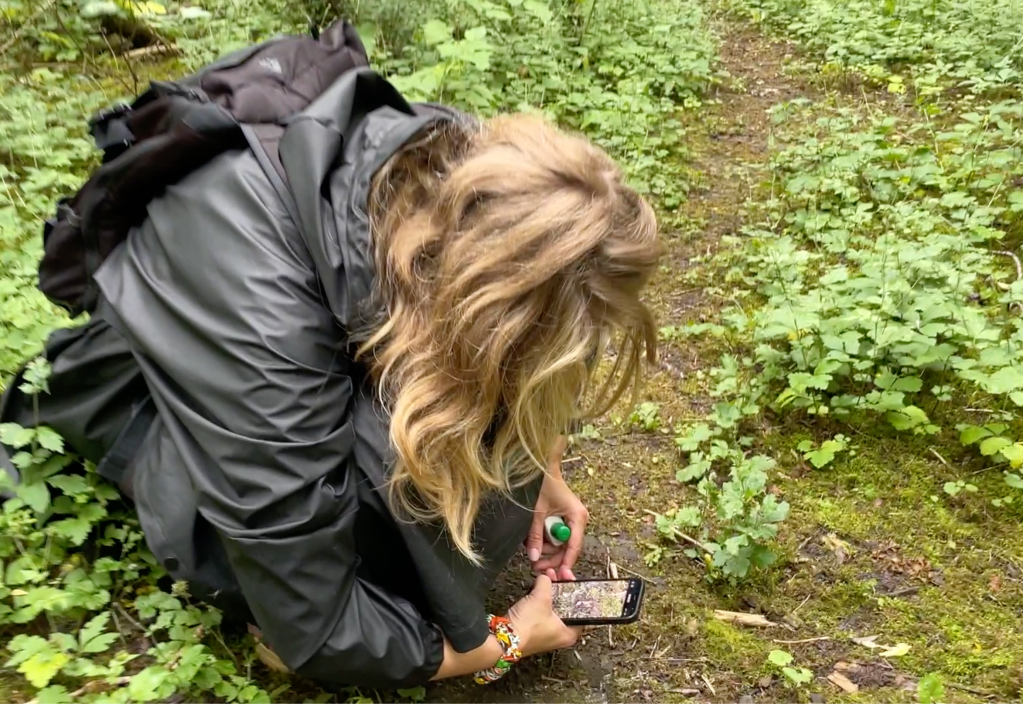
Ecological Data Foraging Workshop
A foraging workshop with ecology-oriented design researchers to rethink data and data practices (including data forms and practices in their research) from an ecological lens. The workshop explores three key aspects of ecological data: embodiment, relationality, and situatedness.

Fabulated worlds from bioscientists
Based on six participants (natural and social scientists)’ outcomes from a fabulation workshop at Wageningen University, I created an image gallery comparing present-day tomatoes (in an open-ended ecology) with their techno-driven futures (in a closed ecology).

Fabulation workshops with designers, farmers, scientists
Developed a fabulation workshop method focusing on a commercialised living organism. The method consists of three parts: “sensitising” the organism to enact alternative data, “contextualising” various data forms, relations, and trends around the organism and its surroundings, and “imagining” possible/impossible evolutions of the organism to reflect ecologically and ethically on the entanglement of various values, practices, knowledge, and visions of specific groups (farmers, scientists, and designers).
Publications & Presentations
International Journal
Youngsil Lee, Chris Speed, and Larissa Pschetz. “Pheno-data: using tomatoes to rethink data and data practice for ecological worlds.” Human–Computer Interaction (2024): 1-23. [View]
Youngsil Lee, Carola Breuer, and Hendrik NJ Schifferstein. “Supporting food design processes: Development of food design cards.” International Journal of Design 14, no. 2 (2020): 51-64. [View]
Peer-reviewed Conference Papers
Sonja Rattay, Robert Collins, Aditi Surana, Youngsil Lee, Yuxi Liu, Andrea Mauri, Lachlan D. Urquhart et al. “Sensing Care Through Design: A Speculative Role-play Approach to” Living with” Sensor-supported Care Networks.” In Proceedings of the 2023 ACM Designing Interactive Systems Conference, pp. 1660-1675. 2023. [View]
Youngsil Lee, Larissa Pschetz, and Chris Speed. “Investigating materiality for a renewed focus on data design practice.” in Lockton, D., Lenzi, S., Hekkert, P., Oak, A., Sádaba, J., Lloyd, P. (eds.), DRS2022: Bilbao, 25 June – 3 July, Bilbao, Spain(2022). [View]
Extended Abstracts: Consortium, Workshop & Provocation
Carlos Guerrero Millan, Sonja Rattay, and Youngsil Lee. “A Manifesto for Other-Than-Human Imaginaries of Data (DIS).” In Companion Publication of the 2024 ACM Designing Interactive Systems Conference, pp. 253-256. 2024. [View] *equal contribution
Youngsil Lee, Larissa Pschetz, Mary Karyda, Oscar Tomico, Danielle Wilde, Tau Ulv Lenskjold, Rachel Clarke, Sara Heitlinger, Ann Light, and Bettina Nissen. “Ecological data for manifesting the entanglement of more-than-human livingness.” In Companion Publication of the 2024 ACM Designing Interactive Systems Conference, pp. 377-380. 2024. [View]
Youngsil Lee, Chris Speed, and Larissa Pschetz. “Pheno-data: knowledge from tomatoes’ becoming with different ecological worlds.” In Extended Abstracts of the CHI Conference on Human Factors in Computing Systems, pp. 1-9. 2024. [View]
Youngsil Lee. “Rethinking data practices for ecological futures: tomatoes as embodied data.”In Proceedings of Nordes 2023: This Space Intentionally Left Blank (Doctoral Consortium), pp. 397. 2023. [View]
Gizem Oktay, Yuta Ikeya, Minha Lee, Bahareh Barati, Youngsil Lee, Yuning Chen, Larissa Pschetz, and Carolina Ramirez-Figueroa. “Designing with the more-than-human: Temporalities of thinking with care.” In Companion Publication of the 2023 ACM Designing Interactive Systems Conference, pp. 104-106. 2023. [View]
Exhibitions
DCODE Final Showcase (17–18 Oct. 2024)
“Data Dilemmas: tomatoes, humans, machines and capitalism”
Self-reflexive installation by collaborating with a bio-artist (materialising concepts of my PhD work), TU Delft making team (building AI sensing machine), Wageningen University (understanding machine vision in agriculture).
NORDES 2023 Exhibition (12–14 Jun. 2023)
“Data, tomatoes and ecological futures”
Self-reflexive illustrations of fabulated stories from natural/social scientists, leaflet for explanation, audience participation sharing their stories in a notebook.
Invited Talks & Panels
[Panel] The Material Image Conference, the National Art School, Sydney. “Pheno-data: using tomatoes to rethink data and data practice for ecological worlds.”
2 Nov. 2024
[Talk] Open Lab, Newcastle University, UK. “Pheno-data: using tomatoes to rethink data and data practice for ecological worlds.”
18 Jul. 2024
[Talk] HCD Lab, Delft University of Technology, NL. “Pheno-data: using tomatoes to rethink data and data practice for ecological worlds.”
29 May. 2024
[Panel] DCODE Winterschool at IT University of Copenhagen, Denmark. “Designerly Imaginaries in the age of data and AI” – Moderator: Miguel Sicart at IT University of Copenhagen
25 Jan. 2024
News

A vocabulary for designing with AI
Nov, 2024
The cohort of DCODE NETWORK introduces new terms and approaches for designing with AI. In this glossary book, I contributed by introducing “Pheno-data” (p. 50)
 YOUNGSIL LEE